
Energy efficiency can no longer be an afterthought for commercial buildings – it’s a regulatory requirement, an investment risk, and now a key factor in property valuation. Whether you’re leasing, selling, refurbishing, or managing a commercial property, understanding Energy Performance Certificates (EPCs) is becoming increasingly essential.
This guide explains what commercial EPCs are, how they’re calculated, possible exemptions, and why upcoming policy shifts could significantly impact property owners and occupiers.
Note: There are significant differences between commercial and domestic EPCs.

What is a Commercial EPC?
A commercial Energy Performance Certificate is a legal document that primarily rates the energy efficiency of a building based on its annual carbon emissions. The building in question is compared to a notional building of the same size, shape and activity (critical) built to 2006 and Building Regs. What is little understood is that the activity of the building is very important. Activity or use case defines the expectations of heating, lighting, cooling, fresh air and occupancy density. These all vary, from offices to retail to warehouses and industrial buildings. The software they are produced on is the same software used to for new buildings to demonstrate compliance with Part L of the Building Regs.
Within a building changing the activity, lighting, heating, cooling within a single room can move a rating up or down. When assessing a building the efficiencies of equipment and lighting are taken where possible as these tend to be better than the default values in the software. Using more efficient lighting or heating and cooling equipment can move a rating up in to a higher band. Thus any refurbishment should include an EPC assessment before work commences to establish the outcome of proposed works. You can design in your B rating.
As of 2023, the commercial Minimum Energy Efficiency Standard (MEES) regulations enforced a minimum energy efficiency of an E rating for all non-domestic properties. The overall rating scale for commercial properties, ranging from A (most efficient) to G (least efficient), is shown below:
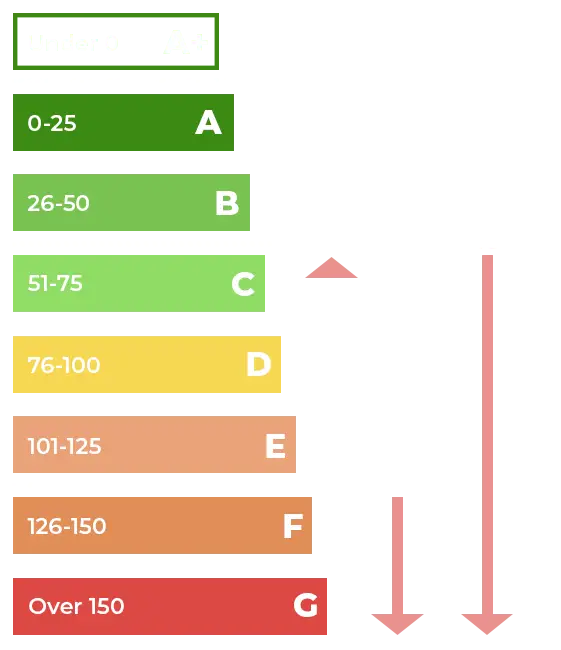
The ratings are directly related to net annual amount of carbon dioxide emissions and therefore a score of 0 indicates a net zero building.
How Are Commercial EPCs Measured?
Unlike domestic EPCs where ratings are based on a property’s estimated running costs, commercial EPCs prioritise carbon emissions to generate a rating. For most properties, the Simplified Building Energy Model (SBEM) is used but for more complex buildings Dynamic Simulation Modelling (DSM) may be used. DSM requires more detail; however, both take into account similar factors, including:
- Property size
- Construction materials
- Insulation levels
- Window type
- Heating system type and efficiency
- Ventilation and air leakage
- Any renewable technologies
- Lighting types and efficiencies
This data is usually collected during an on-site survey by an accredited Non-Domestic Energy Assessor (NDEA), who then inputs this data into the approved software.
Understanding EPC levels: Levels 3,4 and 5 Explained
Due to the large variation in complexity of commercial buildings, there are three different levels that are reflective of their intricacy:
Level 3 – Typically smaller buildings with standard characteristics and simple systems.
- Eg. restaurants, small shops.
- Assessed using SBEM and requires a NDEA.
Level 4 – Typically larger buildings with uncommon characteristics and more complex HVAC Systems. Also required for any commercial new-build.
- Eg. larger offices, supermarkets.
- Assessed using SBEM and requires a level 4 NDEA due to increased complexity.
Level 5 – Specific and more intricate features such as atriums, dynamic control systems and complex ventilation.
- Eg. airports, hospitals.
Assessed using DSM and requires a level 5 NDEA and significantly more time.
When Do You Need an EPC?
You are legally required to have an EPC for a commercial property when you’re selling, renting or constructing a new building. Any EPC obtained is valid for 10 years upon completion, or until a newer EPC is produced for the same property. Check if a building has an existing EPC using the government’s EPC register.
There are some exemptions to requiring an EPC, these include:
- Temporary buildings that will be used for less than 2 years
- Places of worship
- Officially protected and energy improvements would unacceptably alter its character.

MEES Exemptions for Commercial Properties
There are exemptions to the Minimum Energy Efficiency Standard (MEES) that allow you to retain a valid EPC without necessarily having to undertake expensive upgrades to meet the required rating. These exemptions and their requirements are:
- ‘7 year payback’ exemption
You can register this exemption where a recommended measure is not a ‘relevant energy efficiency improvement’ because the cost of purchasing and installing is greater than the saving from that measure over a 7 year period.
- ‘All improvements made’ exemption
You can register this exemption where all the ‘relevant energy efficiency improvements’ for the property have been made (or there are none that can be made) and the property remains below the required rating.
- Wall insulation exemption
You can register this exemption if the only relevant improvements for your property are cavity, external or internal wall insulation and you have obtained expert advice showing these measures would negatively impact the structure or fabric of the property.
- Third-party consent exemption
You can register this exemption if the relevant improvements for your property need consent from another party, such as a tenant, superior landlord, freeholder or planning department, and despite your best efforts that consent cannot be obtained.
- Property devaluation exemption
You can register this exemption if you have evidence showing that making energy efficiency improvements to your property would devalue it by more than 5% according to an independent surveyor.
- Temporary exemption due to recently becoming a landlord
If you have recently become a landlord under certain sudden circumstances, you will not be expected to take immediate action to improve your property to EPC E. You may claim a 6 months exemption from the date you became a landlord.
Is EPC Legislation Changing?
It has always been understood that the following standards will be applied to commercial EPCs going forward but as yet these have not been made law. The B rating by 2030 is the minimum standard that people carrying out works to buildings are aiming for.
- Minimum C rating by 2027
All non-domestic properties will need to achieve at least an EPC rating of C to be let or sold, tightening the minimum requirement from the current E rating.
- Minimum B rating by 2030
By 2030, the bar will be raised again, requiring all commercial properties to meet a B rating. This will demand significant energy efficiency upgrades across much of the existing property stock.
- Reduced validity periods
The current 10-year validity of an EPC may be shortened to provide more up-to-date information, meaning properties would require more frequent assessments to remain compliant.
Why are These Changes Important?
With minimum ratings set to rise in the near future, it is important to treat the current E rating as a temporary floor. Property owners should aim for a C or ideally a B rating to ensure their buildings remain compliant, financeable, and competitive by 2030.
Thinking ahead helps avoid making short-term upgrades that may soon become inadequate, especially if EPCs are required to be renewed every 5 years rather than 10, as the government has proposed. Proactive planning also allows for better budgeting, smoother project timelines, and the opportunity to access funding or incentives for energy improvements, while reducing the risk of future disruption to rental income or property value.
How We Can Help With Commercial EPCs?
With EPC regulations tightening and changing legislation, understanding your property’s energy performance is essential. SEA Consulting delivers expert advice and tailored solutions to help you improve your EPC rating, manage costs and navigate these upcoming changes confidently. We will ensure your property meets future standards in the most practical and cost-effective way.