

Introduction: Sustainable Engineering in 2026
In the 2026 UK commercial real estate market, environmental sustainability has evolved from a marketing differentiator into an absolute financial imperative. Securing institutional "Green Finance," minimizing ESG exposure, and attracting blue-chip tenants depend heavily on achieving top-tier environmental certifications such as BREEAM "Outstanding" or LEED "Platinum." While architectural form dictates massing and thermal envelope performance, the MEP (Mechanical, Electrical, and Plumbing) engineer acts as the primary custodian for more than 60% of the credits required to achieve these scores.
1. The Energy Category: Maximizing BREEAM Ene 01 & LEED EA Credits
The Energy category represents the single most critical scoring arena in both assessment systems. In BREEAM UK, Ene 01 (Reduction of Energy Use and Carbon Emissions) carries massive weighted influence, requiring deep decarbonization of space heating and cooling systems.
Decarbonization via Air Source Heat Pumps (ASHPs)
With the UK's progressive electrical grid decarbonization, fossil-fuel combustion (gas boilers) has been phased out in favor of all-electric heating systems. Specifying central or distributed Air Source Heat Pumps (ASHPs) operating with low Global Warming Potential (GWP) natural refrigerants (such as R290 propane or R744 CO2) allows buildings to achieve low operational carbon scores under Part L 2025/2026 baselines.
Advanced Sub-metering & Smart BMS Integration
To secure maximum points under BREEAM Ene 02 (Energy Monitoring) and LEED Energy Metering, MEP engineers must design an intelligent sub-metering hierarchy integrated into an open-protocol Building Management System (BMS):
- Granular Segmentation: Separate sub-metering for lighting, small power, HVAC plant, domestic hot water, and EV charging infrastructure.
- Automated Fault Detection & Diagnostics (AFDD): Real-time analytics that flag equipment out-of-tolerance behavior before energy waste compounds.
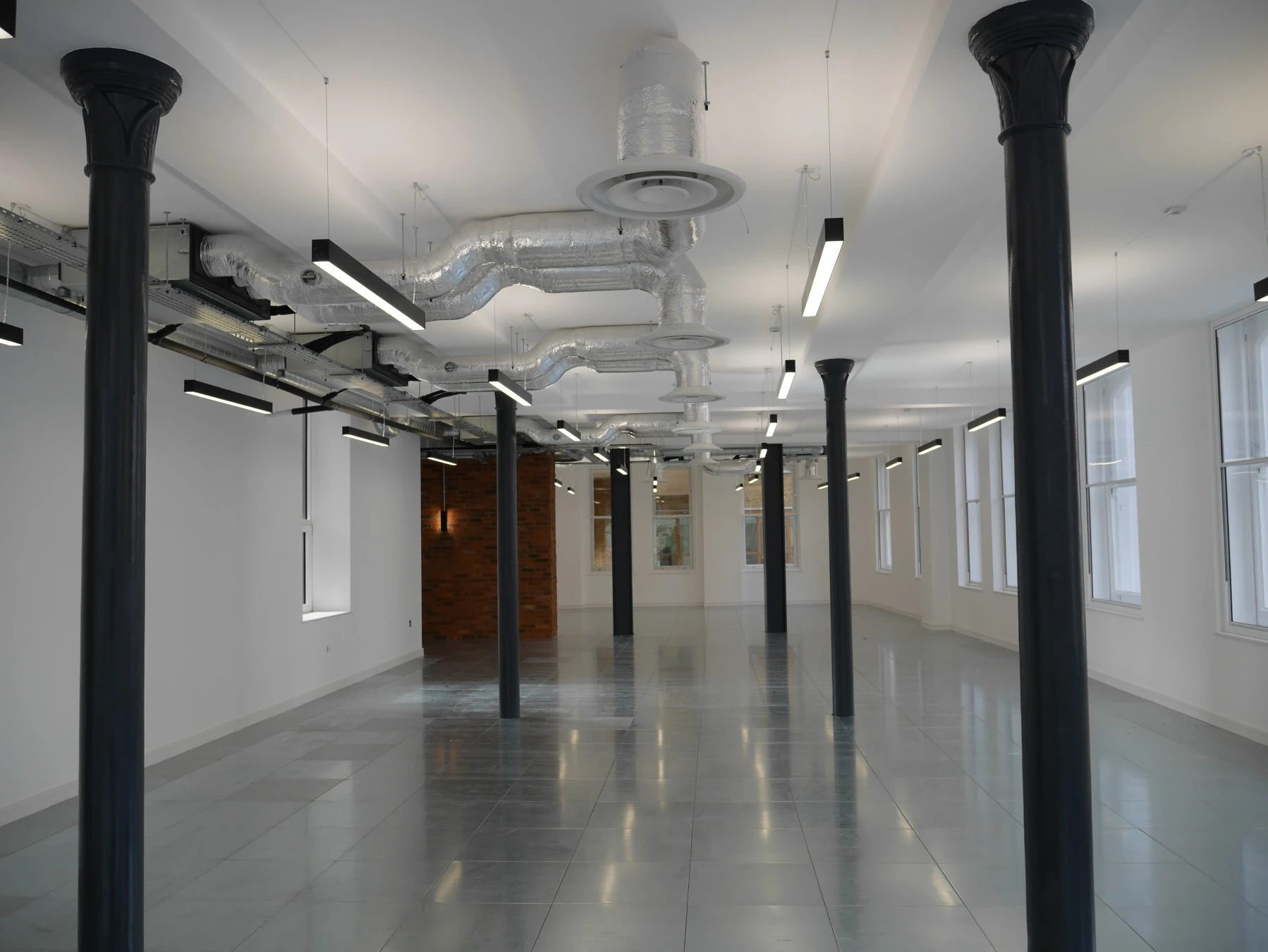
MEP services contribute to BREEAM scores through high-efficiency HVAC, sub-metering, and low-carbon heat sources like Air Source Heat Pumps (ASHPs). Monitoring energy use through a robust BMS is essential for achieving "Excellent" and "Outstanding" ratings.
2. Water Management (BREEAM Wat 01 & LEED WE)
Water scarcity and municipal drainage constraints have elevated the importance of the water efficiency category. MEP public health engineers drive credits through three primary mechanisms:
- Ultra-Low Flow Sanitaryware: Specifying aerated taps, dual-flush cisterns, and waterless urinals to reduce baseline potable water consumption by over 40% without compromising user comfort.
- Automated Leak Detection Systems: Solenoid shut-off valves linked to flow meters that automatically isolate water supplies upon detecting unscheduled flow (satisfying BREEAM Wat 02 and Wat 03).
- Non-Potable Water Harvesting: Integrating Rainwater Harvesting (RWH) and Greywater Recycling systems to treat bath/shower drainage for toilet flushing and landscape irrigation.
3. Health and Wellbeing: Indoor Environmental Quality (IEQ)
Occupant health, cognitive performance, and comfort are central to both BREEAM (Hea section) and LEED (EQ category), as well as aligning with WELL Building Standards.
Indoor Air Quality (IAQ) & Demand-Controlled Ventilation
Mechanical ventilation design must go beyond minimum fresh air exchange rates. Integrating CO2 sensors within occupied zones enables Demand-Controlled Ventilation (DCV). Variable Air Volume (VAV) dampers ramp up fresh air supplies when CO2 levels exceed 800 ppm, preventing stagnation while conserving thermal energy during low-occupancy periods. MERV 13+ or ePM1 55% filtration ensures particulate matter (PM2.5) is effectively scrubbed from outdoor intake air.
Circadian Lighting & Thermal Comfort Zoning
Electrical engineers specify DALI-2 controlled LED fixtures capable of tunable white light, supporting circadian sleep-wake cycles. Simultaneously, mechanical zoning must provide localized thermostatic controls across small thermal zones (typically 30–50 m² per zone), ensuring compliance with CIBSE TM52 (overheating assessment) and CIBSE TM59 standards.
4. Strategic Comparison: BREEAM vs. LEED for MEP Services
While both frameworks pursue environmental excellence, their technical baselines and compliance pathways differ significantly for UK building services engineers:
| Evaluation Area | BREEAM UK (Commercial 2026) | LEED v4.1 / v5 (Commercial) |
|---|---|---|
| Primary Energy Baseline | UK Building Regulations Part L & Notional Building Model | ASHRAE Standard 90.1 Energy Baseline Model |
| Refrigerant Management | BREEAM Pol 01: Strict limits on GWP (<10) and leak detection systems | LEED EA Prerequisite: Zero CFCs + Low GWP/ODP point thresholds |
| Commissioning Scope | BREEAM Man 04: Third-party commissioning & 12-month seasonal testing | LEED EA: Fundamental & Enhanced Commissioning (CxA oversight) |
| Post-Occupancy Requirement | Tied to NABERS UK and BSRIA Soft Landings operational verification | LEED v5: Mandatory operational energy data submission via Arc platform |
5. Closing the Performance Gap: Soft Landings & NABERS UK
In 2026, building performance is evaluated on real-world energy consumption rather than theoretical design calculations alone. Historically, the "Performance Gap"—where actual operational energy use was 2 to 3 times higher than modeled design energy—invalidated theoretical BREEAM credentials.
The BSRIA Soft Landings Framework
To eliminate this disconnect, MEP consultants implement the BSRIA Soft Landings framework. This process requires engineering involvement to extend past practical completion:
- Pre-Handover Training: Comprehensive training of facility management (FM) teams prior to building occupation.
- Aftercare & Seasonal Commissioning: Fine-tuning heating and cooling loops across all four seasons during the first 12–36 months of operation.
- NABERS UK Energy Ratings: Utilizing operational energy modeling (CIBSE TM54) to ensure the building achieves its targeted 5-Star or 6-Star NABERS UK rating in use.
6. Frequently Asked Questions
How does MEP design directly impact BREEAM certification scores?
MEP building services influence over 60% of available BREEAM credits. They directly dictate scores in Energy (Ene 01 sub-metering and low-carbon plant), Water (Wat 01 low-flow fixtures and leak detection), Health & Wellbeing (Hea 02 indoor air quality and daylighting controls), and Pollution (Pol 01 low-GWP refrigerants).
What is the primary difference between BREEAM and LEED for UK building services?
BREEAM (developed by BRE in the UK) evaluates environmental impact using regional UK Building Regulations, Part L baselines, and CIBSE guidelines. LEED (USGBC) uses ASHRAE 90.1 energy baselines. While BREEAM places heavier weight on lifecycle impacts and UK compliance, LEED focuses heavily on global energy performance and material sourcing.
How does the BSRIA Soft Landings framework close the operational performance gap?
The Soft Landings framework extends MEP engineer involvement through construction, handover, and 3 years post-occupancy. Through continuous fine-tuning, seasonal commissioning, and BMS monitoring, it ensures that actual in-use energy consumption aligns with predicted design modeling.
Conclusion
Designing MEP building services for 2026 BREEAM and LEED standards requires a holistic, data-driven approach. By combining electric heat pumps, intelligent BMS sub-metering, circadian lighting, demand-controlled ventilation, and post-occupancy Soft Landings frameworks, UK developers can future-proof their assets, satisfy strict ESG criteria, and secure long-term operational efficiency.